Patios in Fleet, Hampshire & Pagham, West Sussex

Patios Laid Level, Drained, And Below The Damp Course

A patio is the one piece of paving that touches your house, which makes it the one where the levels genuinely matter. Laid too high, it bridges the damp proof course and puts water into the wall. Laid flat, it holds puddles and grows moss.

Pure Lay Home Solutions builds patios, paths and terraces across Fleet, Hampshire, Pagham and West Sussex — porcelain, sandstone, limestone, granite and block, on a full mortar bed with the falls set properly.

Set Below The DPC

Two brick courses clear of your damp course.

Falls Away From The House

Water sheds, rather than sitting on it.

Fixed Written Quote

Itemised price after a site visit.

Local & Family-Run

Hampshire and West Sussex based.

The Thing Most Patio Quotes Never Mention

Your Patio Has To Finish Below The Damp Course

Somewhere near the bottom of your external wall, usually two brick courses above ground, there is a damp proof course — a waterproof layer stopping moisture rising up the brickwork into the house. It only works if it stays above the ground outside.

Build a patio up over that line and you have bridged it. Rain landing on the paving now has a path straight into the wall above the barrier, and it shows up indoors as a tide mark, blown plaster or black mould on the inside of that same wall. It is one of the most common causes of damp we are called out to, and it was created by a patio.

How We Set It

Where a doorway sits low and the level genuinely cannot be dropped, the answer is a drainage channel across the threshold rather than simply building up and hoping. If you already have damp on a wall with a patio against it, our damp proofing page covers what is happening and how it gets put right.

Materials

What We Lay Patios In

The material sets the look, the price and how much upkeep you are signing up for. Here is the honest version of each.

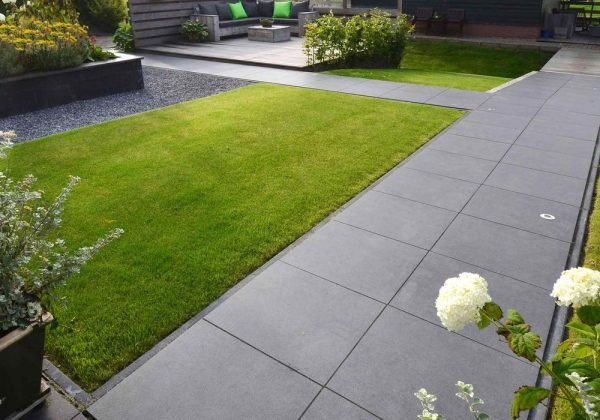
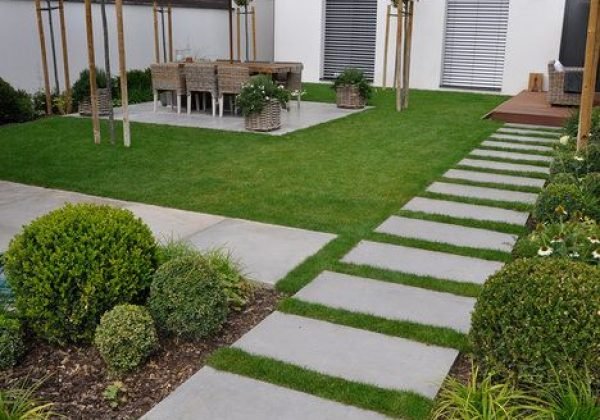
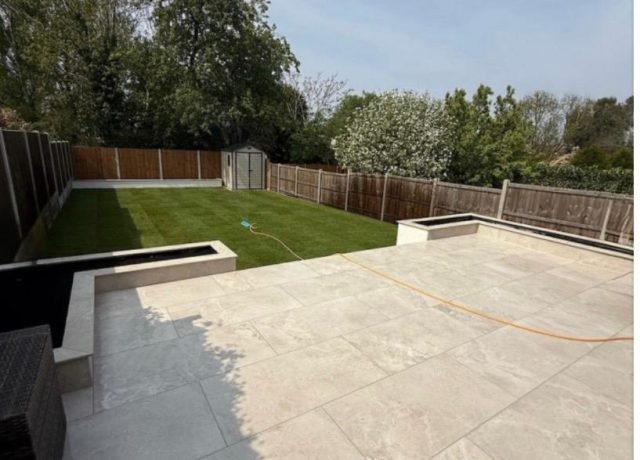
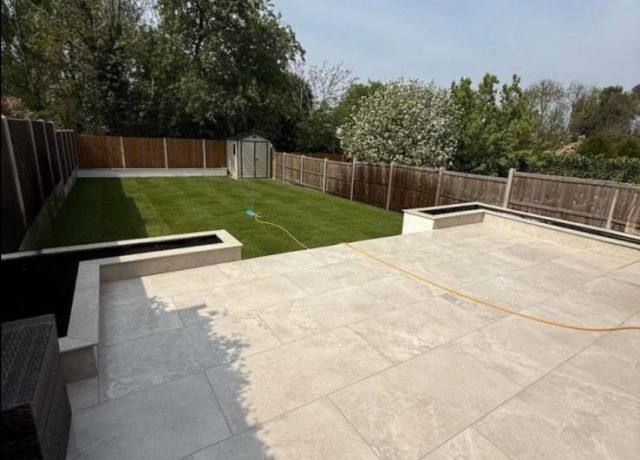
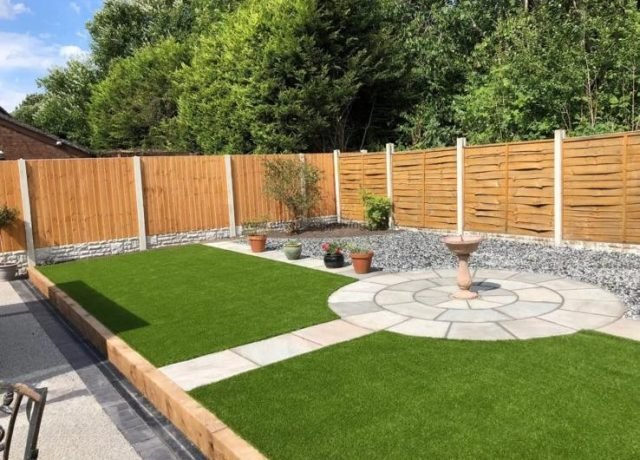
Modern patio with high-quality paving slabs and green space.

Porcelain Paving

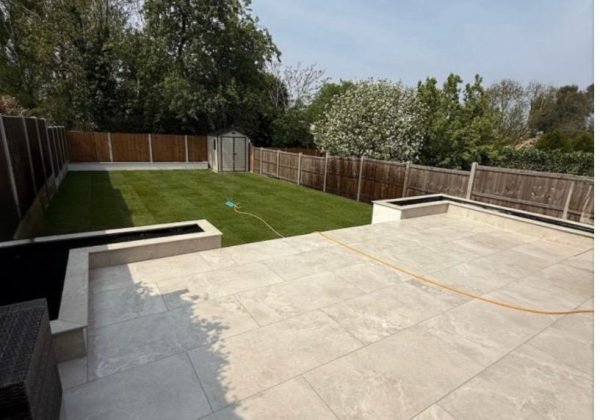
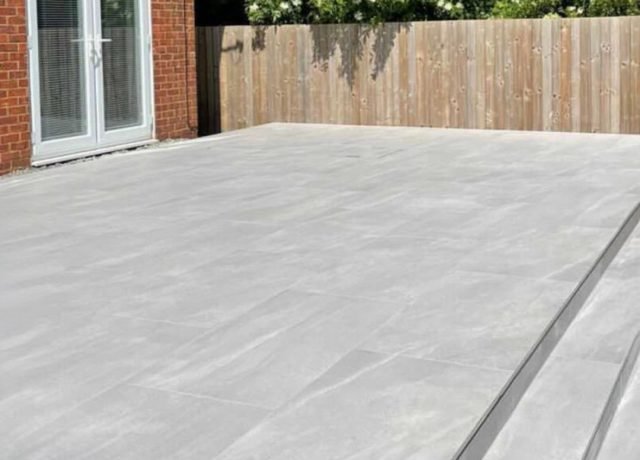
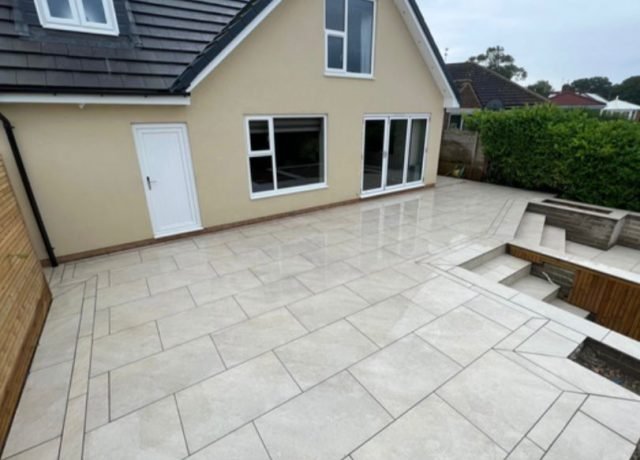
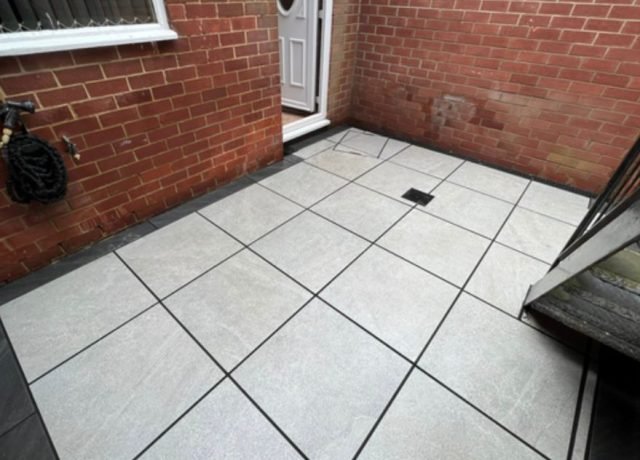
Dense, near non-porous and almost stain-proof, with sharp sawn edges and a consistent colour. The lowest maintenance patio you can buy, and the most expensive to buy and lay — it needs a primer or slurry bond to stick.
WhatsApp Image 2026-04-14 at 2.39.42 PM

Indian Sandstone

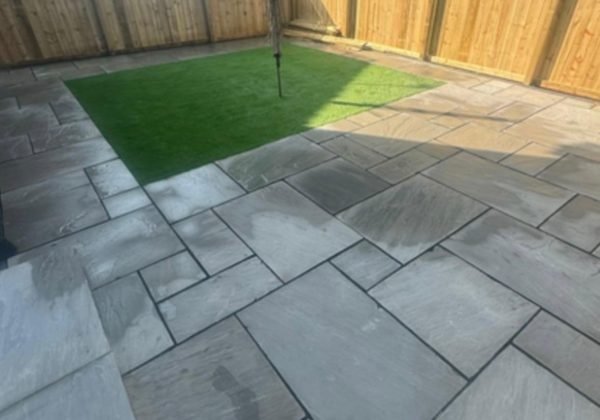
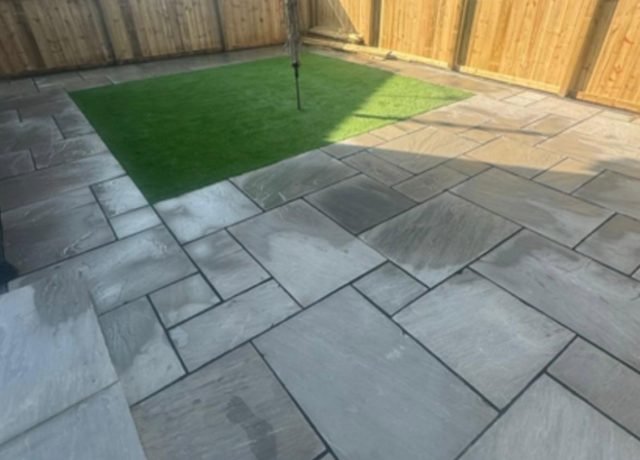
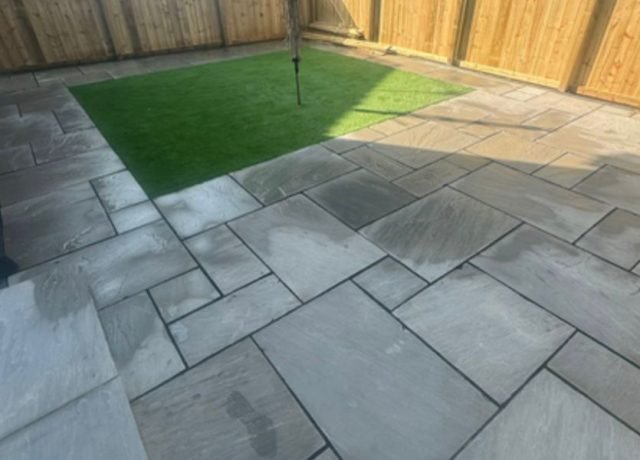
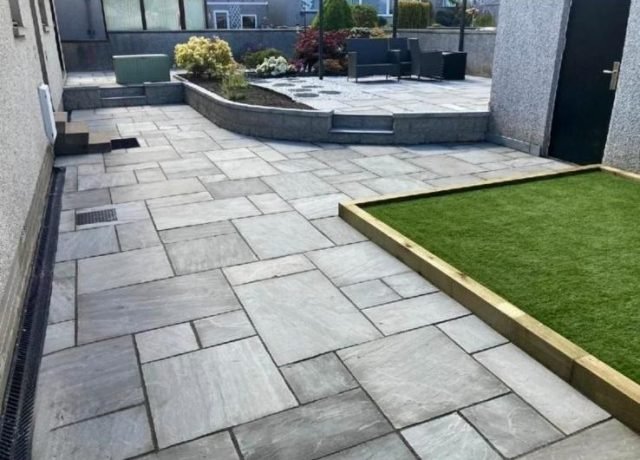
The most popular patio in Britain for good reason: warm, riven, frost-resistant and far cheaper than porcelain. It is porous, so it weathers and needs the occasional wash, which many people prefer the look of.
WhatsApp Image 2026-02-25 at 7.17.56 PM (8)

Limestone & Granite

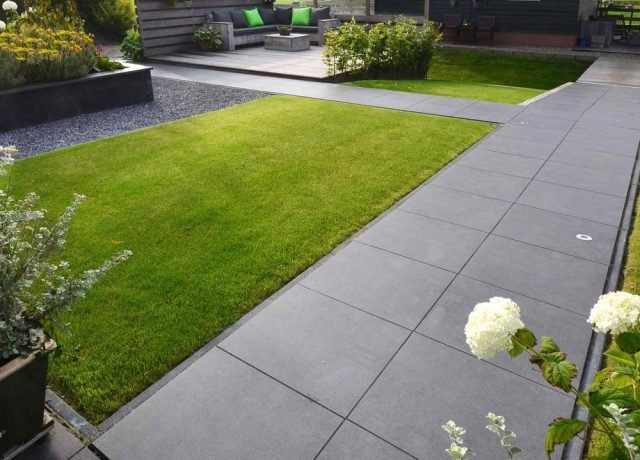
Limestone gives a smooth, even, contemporary surface in greys and blacks. Granite is the toughest natural stone there is — dense, hard-wearing and almost indifferent to weather.
WhatsApp Image 2026-02-25 at 7.17.57 PM (6)

Block Paving & Setts

Small units suit awkward shapes, curves and level changes far better than large slabs, and an individual block can be lifted and replaced. Natural stone setts read beautifully against older houses.
slabbing.2

Paths, Steps & Thresholds

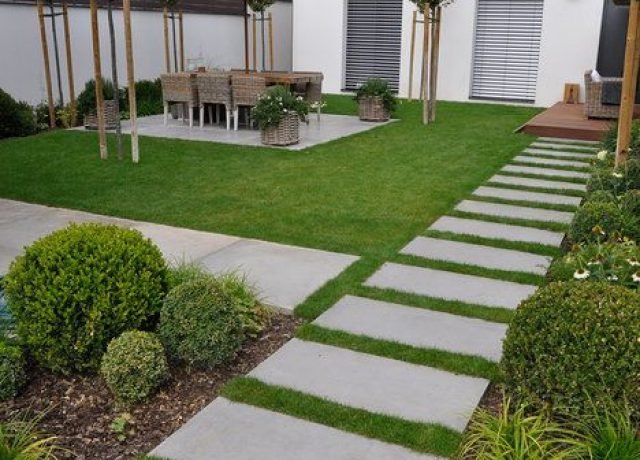
Side access, stepping stones, garden routes and the steps between levels — the fiddly work where the cutting and the falls decide whether it looks considered or improvised.
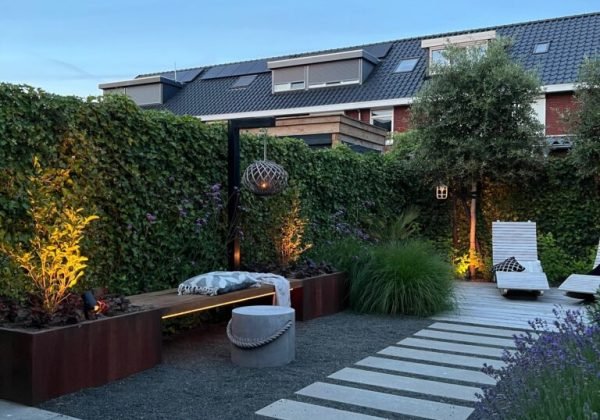
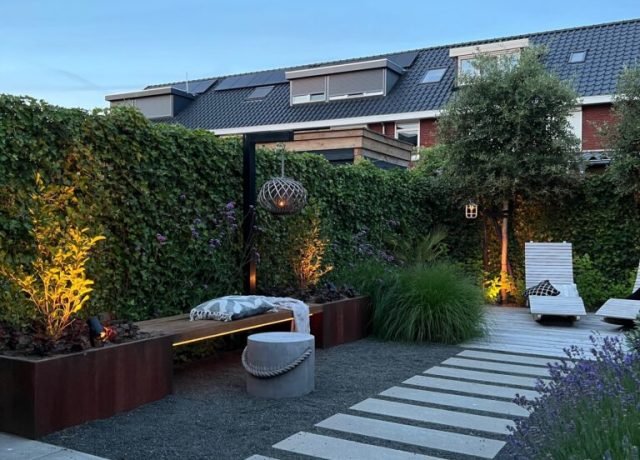
Modern patio with paving stones and decorative garden lighting

Features, Borders & Edging

Circle features, contrasting borders, soldier courses, sleeper edging and built-in seating that frame the patio and tie it into the rest of the garden.

If the patio is part of a bigger garden project, we price it with the rest — there is more on the landscaping page.

Want To See The Stone Before You Choose?

Slabs look completely different wet, dry and in your own light. We bring samples out, lay them against the house and let you see them properly before anything is ordered.

Our Method

Why Patios Sink, Rock And Stain

Almost every patio failure traces back to one of three shortcuts, and all three are invisible on handover day.

Slabs Laid On Dabs

Five blobs of mortar under each slab rather than a full bed. Cheaper and quicker, and it leaves voids that fill with water, freeze, and crack the slab or leave it rocking underfoot.

No Fall, Or The Wrong Fall

A patio laid dead level holds water, grows moss and turns slippery. One falling toward the house sends that water at the wall. The fall is set at the start with a string line, not judged by eye.

No Sub-Base Worth The Name

A patio takes far less weight than a driveway but it still needs a compacted base. Slabs bedded on soft ground or old topsoil settle unevenly within a season or two.

01. Survey & Levels

We find the damp course, set the finished level against it, work out the falls and where the water is going, and put an itemised price in writing.

02. Excavate & Sub-Base

Dig out to depth, spoil away, then compacted sub-base laid and whacked in layers. Edge restraints and any drainage channels set to their finished height.

03. Full Mortar Bed

Every slab bedded on a full mortar bed, primed where the material needs it, and tapped down to line and level. No dabs, no voids, no rocking.

04. Jointing & Handover

Joints filled with a proper pointing compound, the surface cleaned down, spoil taken away and the patio left ready to use once it has cured.

Jointing

The Joints Are Where Patios Age Badly

Nobody asks about pointing at quote stage and almost everybody notices it two years later. It is worth thirty seconds of your attention.

Dry-brushed sand and cement, still used on plenty of cheaper jobs, is the one to avoid: it cracks out within a couple of winters, lets weeds in and leaves a grey haze across the slabs that never fully washes off. It is a false economy on a patio you will be looking at for twenty years.

Cleaning & Refurbishment

Your Patio May Not Need Replacing

A tired-looking patio is often a dirty one. Before quoting a rebuild we will tell you honestly whether a clean and a re-point would get you most of the way for a fraction of the cost.

Refurbishment

Where the problem is structural — a patio bridging the damp course, or one that has sunk because there was never a base under it — we will say so. Cleaning a patio with a levels problem just gives you a clean patio with a levels problem.

Why Pure Lay Home Solutions

Why Homeowners Trust Us With Their Patio

Patios are the easiest paving job to make look good for a year and the hardest to make right for twenty. The difference is entirely in the parts you cannot see on the day it is finished.

We Check The Damp Course First

Before anything is priced. We also fix damp for a living, so we see where bridged patios end up — and we are not willing to build you one.

Itemised Fixed Quotes

The price states the excavation, the sub-base, the bedding, the material and the jointing compound, so you can compare quotes on something other than the total.

Straight Advice On Material

Porcelain is not always worth the premium, and sandstone is not always the bargain. We will tell you which suits your aspect, your usage and your budget.

We Leave It Clean

Mortar cleaned off the face as we go, the garden swept, spoil taken away and a safe route to your back door throughout.

Recent Work

Patios We Have Built

Porcelain, sandstone and slabbed patios, paths and terraces completed for homeowners across Hampshire and West Sussex.

Costs, Timescales & Upkeep

Straight Answers Before You Commit

What Does A Patio Cost?

Priced per square metre, and the material is the biggest single variable — porcelain typically costs a good deal more per metre than sandstone, before the extra labour it needs to lay.

After that it is how much has to come out and go away, how much cutting the shape needs, whether there are steps or retaining walls, and access. We measure up and give you an itemised figure rather than a rate over the phone.

How Long Does It Take?

A straightforward rear patio is usually three to five days on site. Add steps, walls, a circle feature or awkward access and it stretches toward a week or more.

Give the mortar and the jointing a couple of days to cure before putting furniture on it. We will tell you exactly when it is ready to use before we leave.

Should I Seal My Patio?

It depends entirely on the material. Porcelain is effectively non-porous and does not need sealing at all. Sandstone and limestone are porous, so a sealant makes spills easier to deal with and slows staining — but it has to be reapplied every few years and it slightly changes the look.

It is optional rather than essential. We will tell you where it genuinely earns its cost.

Will It Go Green And Slippery?

Any paving in shade will grow algae eventually — it is the damp, not the stone. A patio laid with a proper fall dries out between downpours and grows far less of it.

A wash-down once or twice a year deals with the rest. Porcelain and granite stay cleaner longest; riven sandstone holds a little more in its texture.

FAQs

Frequently Asked Questions About Patios

Clear answers to the questions we are asked most often about patio materials, levels, costs and upkeep.

The finished paving should sit at least 150mm — about two brick courses — below the damp proof course, with a fall running away from the wall. If a door threshold makes that impossible, the correct answer is a drainage channel across the threshold, not building the level up. This is the single most important measurement on a patio job and it is the one most often ignored.

Porcelain is denser, near non-porous, colour-consistent and about as low-maintenance as paving gets — but it costs more to buy and more to lay, because it needs a primer or slurry bond and it is harder to cut. Sandstone is warmer, riven, considerably cheaper and weathers naturally, which many people prefer. For a shaded north-facing patio that will get dirty, porcelain earns its premium. For a sunny traditional garden, sandstone is often the better call.

We would rather not, and usually will not. Laying over an old patio raises the finished level by the thickness of the new slabs plus the bed, which is exactly how a patio ends up bridging the damp course. It also means you are building on someone else’s base without knowing what is under it. Lifting the old paving is a day’s work and it is the difference between a patio that lasts and one that repeats the last one’s faults.

Roughly 1 in 80 — about 12mm of drop per metre — running away from the building. It is enough to shed water without being noticeable underfoot or making furniture sit oddly. Where the patio cannot drain away naturally we design in a channel drain or a soakaway at survey stage.

For a patio in a rear garden, almost never. The five square metre rule that catches driveways applies to front gardens where water would run onto the road. Raised terraces and decking above a certain height can need permission, and listed buildings and conservation areas have their own rules. We will flag it at survey if we think yours is affected.

Usually because the slabs were bedded on dabs of mortar or on soft ground rather than a compacted sub-base, so they have settled where the load is heaviest or the ground is softest. Sometimes it is water: a leak or a downpipe discharging under the paving washes the bedding out. We lift the affected area, find out which it is, and re-bed properly.

For most patios a brush-in jointing compound, which stays slightly flexible and resists weeds and frost. Porcelain with narrow joints is better suited to a wet slurry grout. What we avoid is dry sand and cement brushed into the joints — cheap, common, and it cracks out within a couple of winters while leaving a haze across the slabs.

Often we can get close, though be realistic: natural stone varies batch to batch and existing paving has weathered, so a repair is rarely invisible. Where an exact match is not achievable, a deliberate contrast — a border, a different material for the new section — reads far better than a near-miss that looks like an accident.

Fleet, Farnborough, Aldershot, Camberley, Basingstoke and the wider Hampshire area, and from our Pagham base across Bognor Regis, Chichester and West Sussex. If you are not sure whether you are in range, call and ask.

Get A Free Patio Quote

    Speak To Us Direct

    Get In Touch

    Get Your Patio Built Properly

    Book a free site visit and we will check the damp course, measure up, bring the stone samples out and put a fixed itemised price in writing — across Fleet, Hampshire, Pagham and West Sussex.

    Elvetham Bridge Unit 1, Fleet, GU51 1AE